

Koschei the Deathless: The Darkest Villain in Slavic Folklore Explained
If you spend any time wandering through Slavic folklore, you’ll notice that most monsters have a weakness, a loophole or a bargaining chip you can use. Even the scariest ones usually come with a way out if you’re clever or brave enough to try. Leshy can be outsmarted. You fight Zmey Gorynych and win a battle if you know your way around a sword. Baba Yaga might threaten to eat you, but she might also give you directions if you behave appropriately (and bring the right gifts 😉).
But then there’s the one character that rises above all of them. He doesn’t negotiate. You can’t bribe him, and he doesn’t really obey the usual rules of Slavic myths.
That’s Koschei the Deathless, a.k.a Koschei the Immortal.
And yes. He’s exactly as dramatic as he sounds.
The Villain Who Refuses to Play Fair

Koschei is the embodiment of “a bad guy” in the way fairy tale villains usually are, but he is also a force of nature that decided to take humanoid form and develop a serious personality problem. He doesn’t get tricked easily. He doesn’t search for redemption. And he absolutely does not do the “misunderstood antagonist with a tragic backstory” routine unless you count “being immortal and emotionally unavailable forever” as tragic.
Arrows, bullets, swords—nothing works against him because mortal weapons cannot kill him. Bribery? He couldn't care less. Friendship? Good luck with that. Even getting a conversation started that doesn’t end in existential dread is impossible.
He’s often described as something close to Universal Evil, and not in a cute, cartoonish “I twirl my mustache” way. Do harm is his default setting. No moral hesitation. No regret.
Where Koschei the Deathless Comes From (And Why That Matters)
Koschei may actually come from the deep end of Slavic mythology.
In some traditions, Koschei the Deathless is described as the youngest son of Chernobog, a deity tied to darkness, misfortune and everything humans instinctively fear. On top of that, he’s often said to rule over the Nav, the realm of the dead. So right away, we’re not dealing with someone who merely visits the underworld but belongs to it.
There’s also another theory that gives Koschei an even colder edge. Some scholars connect him to Karachun, a figure associated with death, winter and the quiet ending of life. In Belarusian folklore, Karachun can shorten a person’s lifespan, causing sudden or premature death.
What’s in a Name?
One of the coolest things about Koschei is that even his name feels like it’s been through multiple translations, dialect shifts and folklore telephone games.
You’ll see versions like Kashchei, Kashch or Kashcha. In Ukrainian tradition, you’ll hear names like Kostei or Kostiy, which in Slavic languages it sounds amazingly close to the word “bones”.
And it’s not a coincidence. Across many regional interpretations, Koschei visually associated with skeletal looks—thin, gaunt, almost bone-made. Not always literally a skeleton, but the idea of one. Even in some dialects, the word “koschei” is used to describe an emaciated person—someone so thin they’re basically “a walking skeleton.”
But the most fascinating thing is that the origin might not be purely Slavic. Older records connect the term to meanings like “captive” or “slave,” possibly linked to Turkic roots, which adds a very different flavor—Koschei is death-like, but he might also be someone bound or trapped.
It’s kind of ironic for a character known for being unkillable.
Searching for Koschei the Deathless Is Basically a Side Quest From Hell
In folklore terms, finding Koschei isn’t a “go over there” situation and you’ll find him.
It’s a full-blown pilgrimage. We’re talking extreme endurance levels. Heroes wear out iron boots, iron coats and iron hats. And that’s not a metaphor. The myth basically tells you, “This journey is going to grind you down until you are something else entirely.”
And of course, the destination isn’t marked on any map. Koschei’s realm sits at the “edge of the world.” Mythologically speaking, he lives in the place where reality starts to break down. Along the way, heroes deal with impossible landscapes, shifting alliances, magical helpers, betrayals and sometimes even literal death-and-resurrection sequences just to keep the plot moving.
Because Koschei doesn’t live in the mortal world. He lives beyond it.
The Kingdom That Looks Too Shiny to Be Safe

Koschei’s home is never the same. Sometimes it’s a castle. Sometimes a palace. Sometimes just a house with golden windows that feels way too nice to trust.
Gold, silver, pearls—no matter how his place of residence looks, it is always filled with treasure. But mythologically, that richness doesn’t mean “wealth.” It means you’ve crossed into the “Other” world, as in the Realm of Death.
Everything is too perfect. Too bright. Too colorful. Nothing about his place is natural. And Koschei sits right in the middle of it like he belongs there more than anywhere else.
The “Smells Like a Human in Here” Problem
One of the most iconic recurring moments in Koschei tales is surprisingly sensory.
Koschei (and sometimes characters like Baba Yaga) can detect humans by smell, and the line usually goes something like: “Foo, foo, foo… something smells of the Russian spirit.”
Which sounds poetic until you realize it basically means: “There’s a human here. I know because reality just shifted slightly.”
And Koschei always notices. Because… well… of course he does.
So, What Does He Look Like?
Curiously, folklore never fully agrees on his looks.
Koschei is often described as an old, gray-haired man with a long beard. Sometimes the beard is longer than his entire body, which already feels like a power move. Sometimes he’s so small you could mistake him for a sparrow, except for that massive beard dragging behind him like a cursed scarf. Sometimes he has bird-like qualities and turns into a raven. Other times he’s tall and thin, almost skeletal.
And then there’s the blindness motif. Koschei is someone who cannot see in a normal way but perceives everything anyway. He doesn’t need eyes to know where you are.
That’s the scary part.
Sometimes He Starts as a Prisoner
In some legends, Koschei starts as a captive. Sometimes he’s trapped in a dungeon for decades—chained, burned, starved. Despite all that, he doesn’t die because death simply refuses to apply.
Quite often, the reason he’s imprisoned is tied to desire, rejection or conflict with a heroine figure who outmatches him in will or magic. So you get this strange reversal—Koschei, the “ultimate villain,” temporarily becomes the one who is contained.
But don’t relax too much. Usually, that doesn’t last.
His Complicated Power
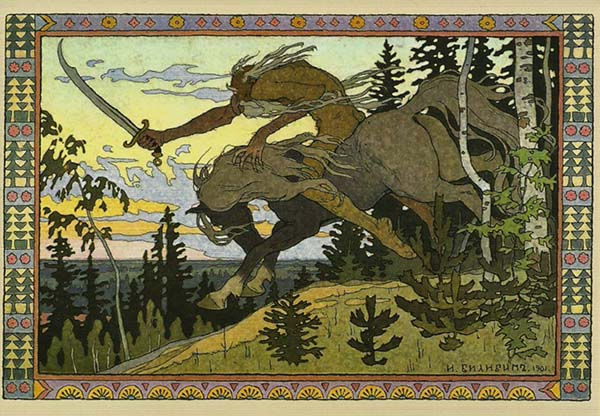
Koschei likes to make a dramatic entrance. He arrives like a storm. Thunder rolls. Hail falls. Wind tears through trees, and leaves rip off branches.
In many stories, he flies instead of walking, and when he moves, the world reacts to his presence. Even legendary, oversized and mythically strong warriors get blown away like they weigh nothing.
Koschei can lift absurd weights, fight for entire days and carve through armies. But he’s not infinite. And that matters.
Because folklore always leaves a crack in the impossible.
The Egg Problem (a.k.a. His Entire Life Is a Nesting Russian Doll)
Koschei’s immortality is literally stored somewhere else. I know it’s hard to wrap your head around this concept, but his “death” exists outside his body, hidden in a sequence of increasingly absurd containers—an egg inside a duck inside a hare inside a chest inside an oak tree on a distant, impossible island.
It’s basically a mythological escape room designed by someone who hates you.
So it you think about it, Koschei doesn’t die because his death exists somewhere else entirely. To kill him, you don’t fight him. You solve his puzzle.
And that’s the reason why heroes usually need help. Usually, animals spared earlier in the journey provide the assistance they need.
Brute force is not going to help you. You need balance, and that’s the one thing Koschei can’t fully control.
So What Is Koschei, Really?
Koschei is a villain, but he’s also a lot more than just that. He represents immortality without purpose, power without warmth, knowledge without transformation.
He’s what happens when “forever” stops being a gift and becomes a trap. But in his case, he doesn’t seem interested in escaping it.
And that’s what makes him so effective in folklore. He’s scary because he doesn’t feel like he’s playing the same game as everyone else.
Even death has to work around him.
Final Thought…
Koschei fits surprisingly well into modern fantasy and urban fantasy storytelling. He feels like something that could slip into a city at night, existing just outside the rules, just beyond the camera angle.
He is a concept you keep rediscovering in different forms—immortality, obsession, control, the fear of something that simply cannot end, and maybe that’s why he makes such an effective villain in folklore.
Because deep down, every myth needs at least one character who refuses to be solved easily.
References:


Comments